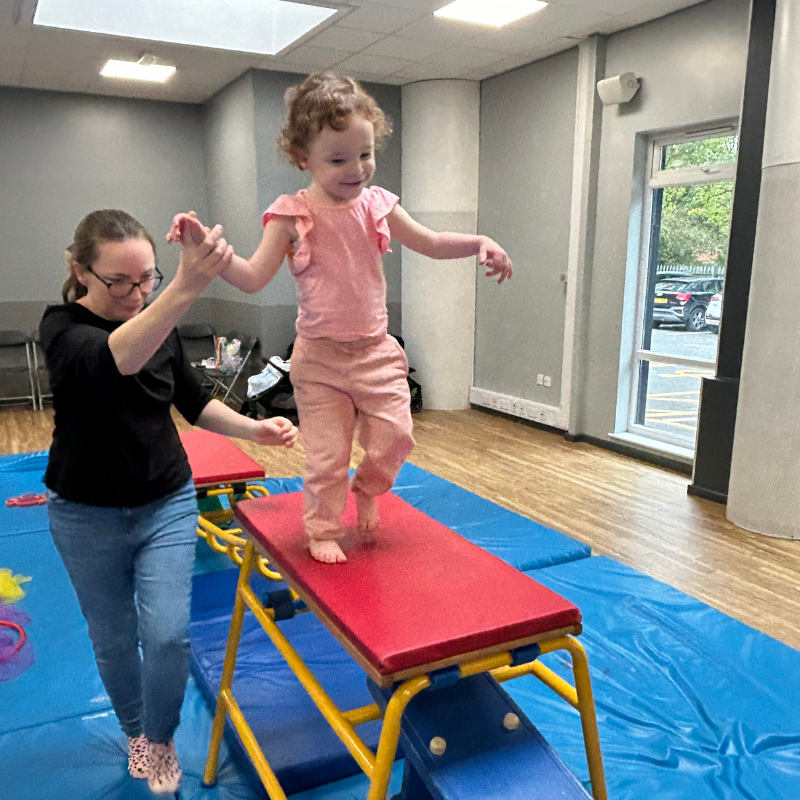
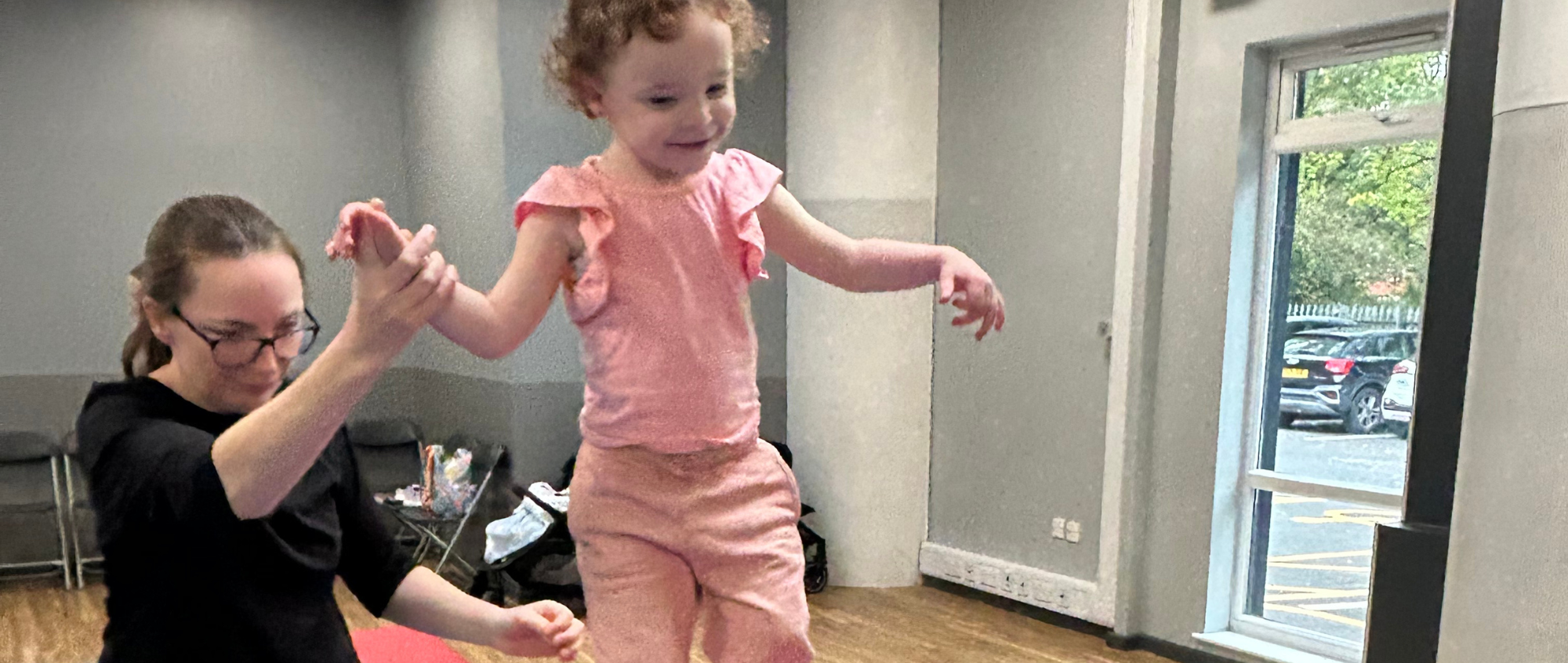
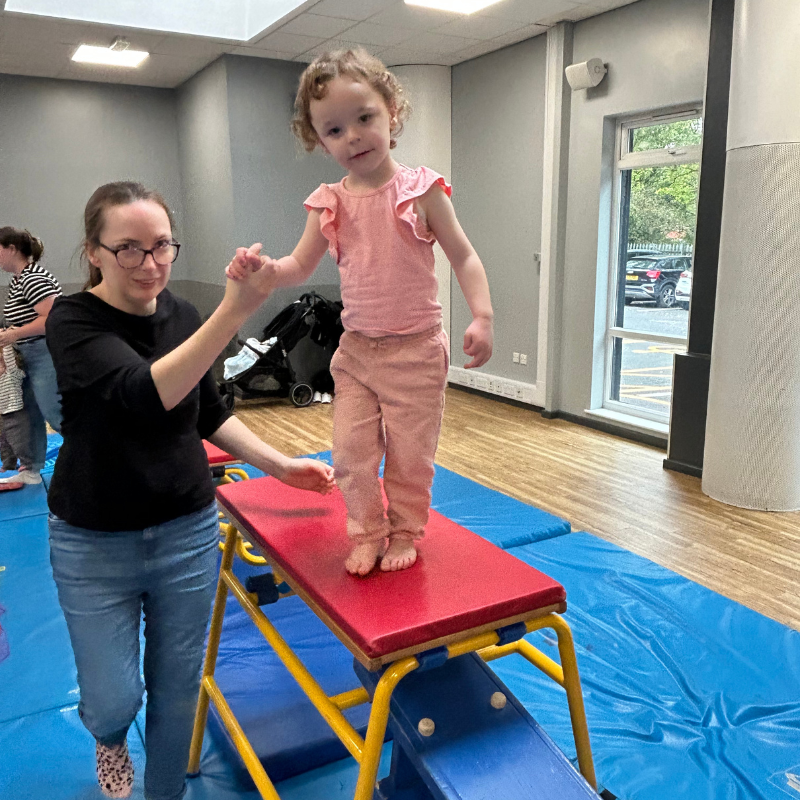
For almost a year Kirsty, and her three-year-old daughter Freya, have been attending Baby Gym at Worsley Leisure Centre, part of the SCL Gymnastics programme. Freya has shown signs of neurodivergence from a very early age. With her older son, Ollie, also being neurodivergent, Kirsty recognised the signs quickly.
However, what makes Freya different doesn’t phase Kirsty, she just wanted to make sure Freya could be involved in as much as possible and enjoy a ‘normal’ childhood.
It was this mindset that led her to discover Baby Gym.
Kirsty began looking for gymnastics classes after noticing Freya’s high energy and fearless nature.
“Freya has no sense of danger,” she says. “She throws herself around a lot, especially off furniture. So I started looking for gymnastics classes in the area.”
A simple Google search led her to Baby Gym. “It works really well for us with the timing. I don’t drive and Worsley Leisure Centre is within good walking distance from home, so I thought we’d give it a go.”
The welcoming atmosphere struck her immediately.
From minute one it felt very welcoming and inclusive!
Kirsty recalls.
“I’ve always been very open about Freya’s difficulties; her speech delays and everything that goes with neurodivergence. Even though we haven’t had an official diagnosis, the instructors listened and took us at our word. There was no awkwardness at all.”
She immediately felt safe and supported:
“I felt like Freya was totally safe with Paige and Jill. From minute one, they were able to give her the extra attention she needs without hovering over her or limiting what she can do.”
Freya has her own way of engaging with activities, and Kirsty appreciated how naturally the instructors adapted.
“Freya doesn’t always play the games to the ‘agreed rules’. She’ll often interact, but sometimes she makes up her own rules. Paige and the team always work around her or even join in with her games.”
Over the months, the changes in Freya have been unmistakable.
She seems to have gained a lot of confidence from attending Baby Gym!
Kirsty says. Freya now approaches equipment and activities with excitement rather than uncertainty.
Although she doesn’t participate in typical group play, Kirsty has seen real progress.
She doesn’t always play ‘with’ other children, it’s more that she’ll play near, or alongside them. But, she recognises them now. She’ll acknowledge them and play close to them, which she never used to do.
One of the most meaningful shifts has been her growing awareness of risk.
In the past, she’d just throw herself off the edge of stuff. It would mostly be furniture, with a soft landing, but it still made me nervous. Now she actually climbs down safely. The activities have helped her gain a bit of a sense of danger, and taught her skills like climbing down to help her manage risk.
Freya’s vocabulary has been blossoming.
Her speech and language have come on so much. She’s learned the names of certain equipment and activities. The instructors add educational elements into the games too, and because she’s so engaged with the gymnastics, that’s helping her learn in a way that suits her.
Something Kirsty hadn’t expected:
Freya really struggles with regulating her sleep, but we’ve noticed she always sleeps better on a Thursday night after gymnastics.
One standout part of Freya’s experience is her connection with her instructor.
Freya has developed a really special bond with Paige. Whenever we tell her she’s going to gymnastics, her face lights up.
Freya loves sharing her progress:
“If she’s learned a new word or skill, she wants to show Paige. It’s really nice. It can take her a while to warm up to people, but with Paige she just had an instant connection. It’s been lovely to watch that bond grow”
The supportive environment has made a big difference for Kirsty as well.
“Sometimes you go to a group and worry there’ll be judgement, or people will look at Freya funny for not doing things the same way as the other children,” she says.
“But we’ve never had that at Baby Gym. The whole group has always been so accepting. No one bats an eyelid when Freya is doing things her way.”
Even the parts Freya originally found difficult have evolved naturally.
“She’s only just started being settled during the songs session at the end,” Kirsty explains. “Before, she’d wander off and do her own thing, but there was never any pressure from the instructors or the rest of the group. Now she’s engaging with it in her own time.”
Kirsty is clear in her message to other families:
I would definitely recommend anyone to try Baby Gym. It’s such a welcoming and inclusive session.
And to parents of neurodivergent children in particular:
“Try everything. Don’t write things off if the first session doesn’t go perfectly. It took Freya months to join in with the songs and rhymes part of the Baby Gym sessions and now she loves it. Let them do things in their own time.”
The progress Freya has made over seven or eight months has been deeply rewarding for Kirsty to witness.
I’ve noticed such a positive change. It’s great for her to have a safe space to play, be herself, and just be accepted for who she is.
Freya starts a new nursery schedule in January, but Kirsty has already planned ahead:
“I’ve arranged for Thursdays to be one of her days off so she can keep doing the gymnastics session she loves.”
Baby Gym is suitable for babies and children aged 9 months and over and is available at the following times and locations:
*Sessions held during term time only
Sign up to the Salford Community Leisure mailing list and be the first to find out about our latest news, offers and forthcoming events across our services.